From Physical Medium to Digital Visual Transformation
Introduction
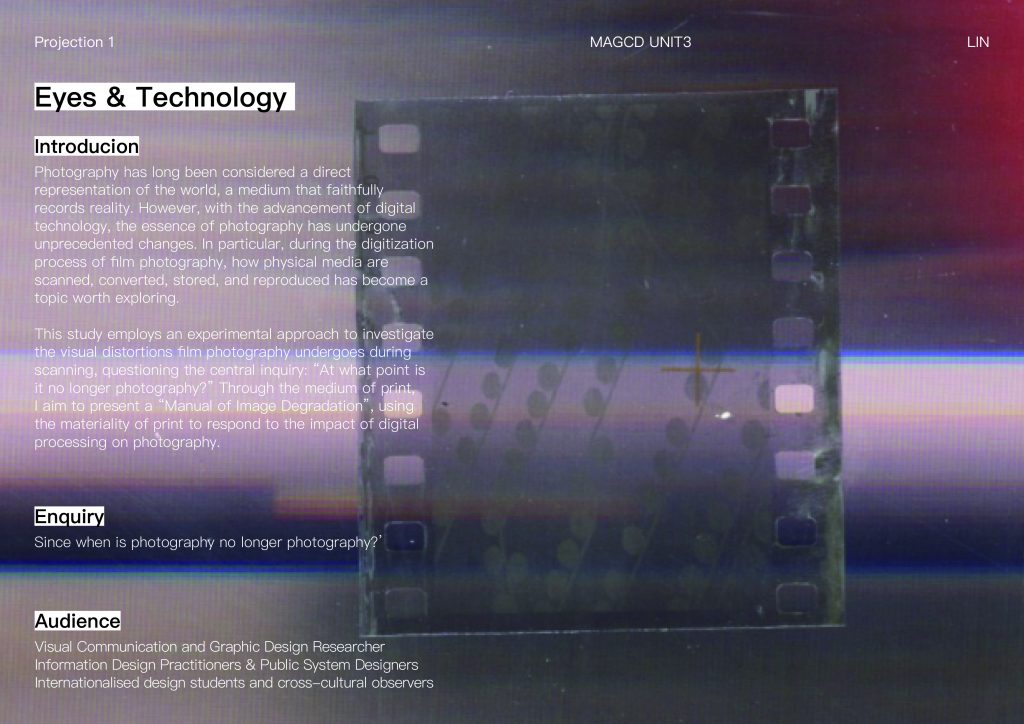
Photography has long been considered a direct representation of the world, a medium that faithfully records reality. However, with the advancement of digital technology, the essence of photography has undergone unprecedented changes. In particular, during the digitization process of film photography, how physical media are scanned, converted, stored, and reproduced has become a topic worth exploring.
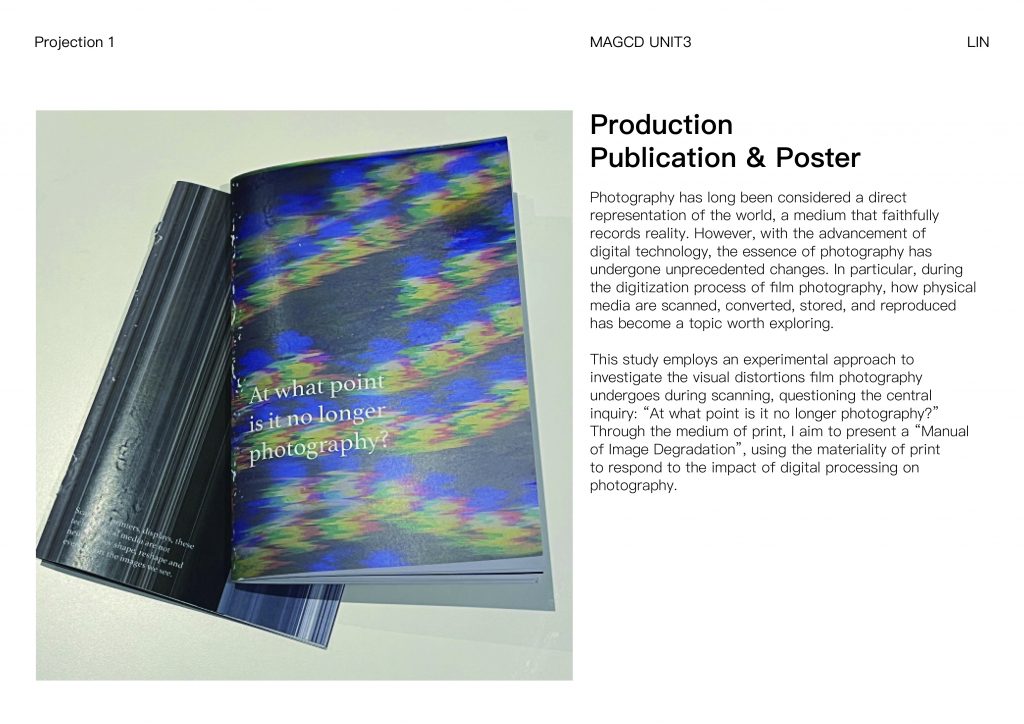
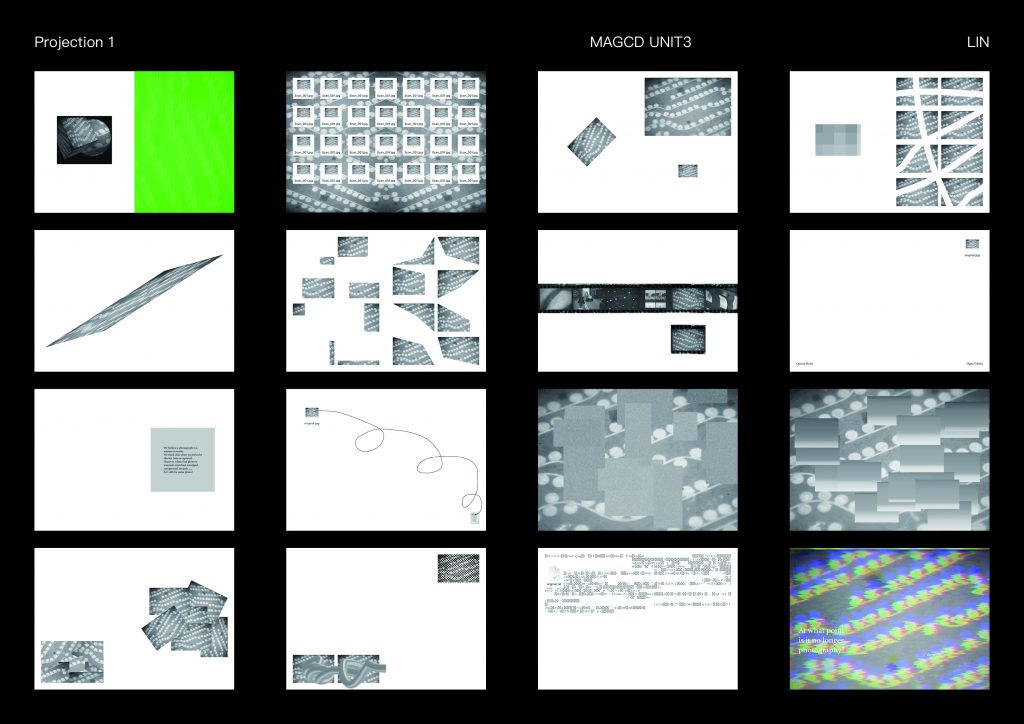
This study employs an experimental approach to investigate the visual distortions film photography undergoes during scanning, questioning the central inquiry: “At what point is it no longer photography?” Through the medium of print, I aim to present a “Manual of Image Degradation”, using the materiality of print to respond to the impact of digital processing on photography.
1. Film and Scanner: The Beginning of Conversion
The fundamental difference between film photography and digital imaging lies in their respective recording methods: film captures images optically, while scanners read images digitally. During this transformation, the scanner is not a passive tool but an active visual agent—its resolution, color algorithms, and light source characteristics all influence the final image (Batchen, 1999).
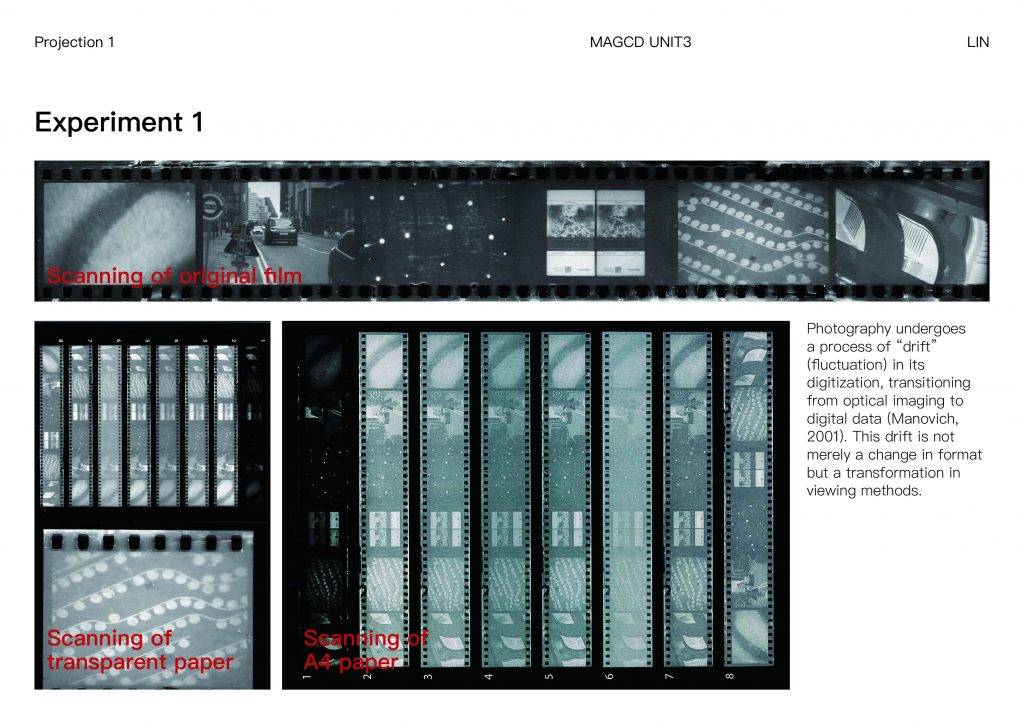
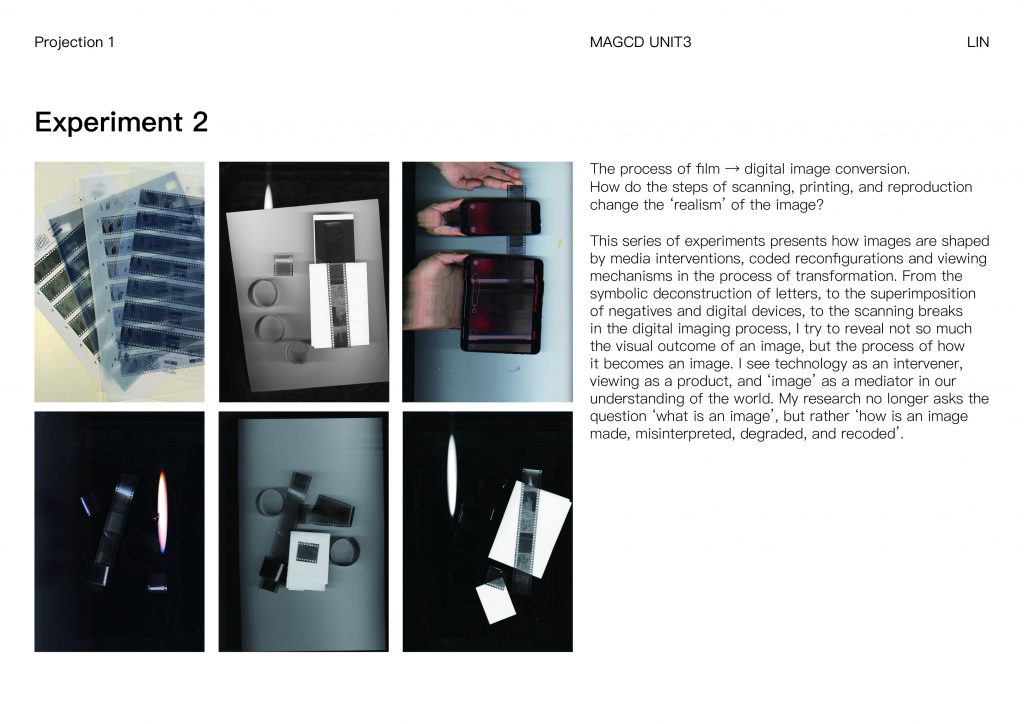
In my experiments, I used different scanning methods on the same film, including:
- Rotating, stretching, cropping, and blurring to test the visual threshold of an image;
- Observing how the scanner’s light source affects film imaging;
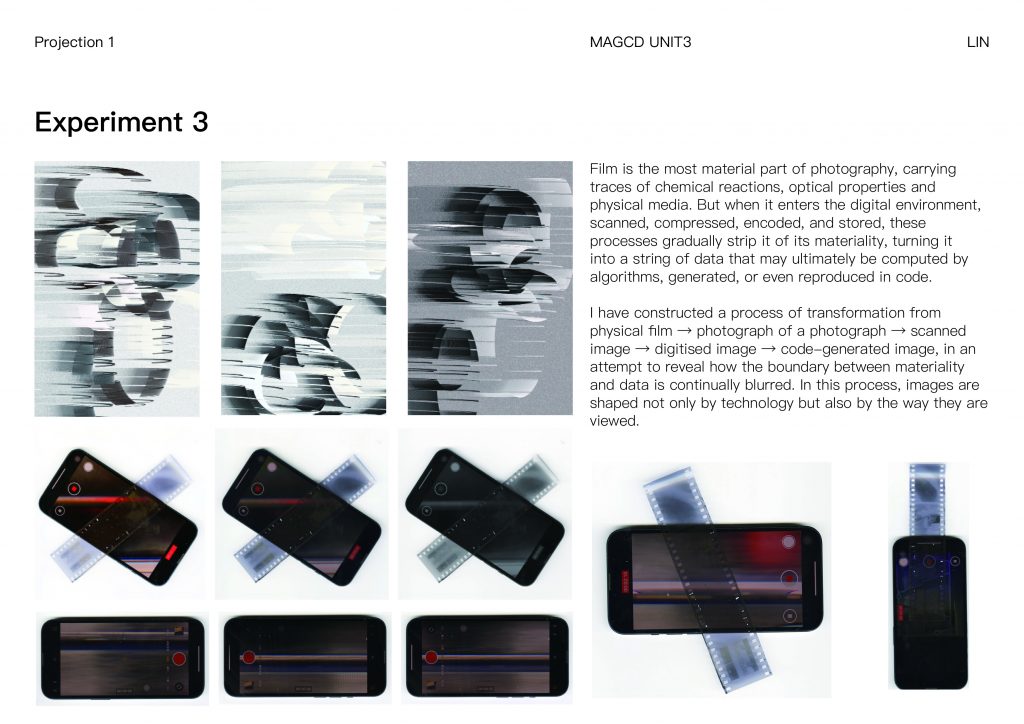
- Examining artifacts introduced by the scanner, such as streaks, moiré patterns, and digital noise (Mitchell, 1992).
Through these experiments, I explored how the scanner does not merely reproduce images but actively creates them. When scanner-induced errors become part of the image, can it still be considered photography?
2. Visual Drift: From Photography to Digital Images
Photography undergoes a process of “drift” (fluctuation) in its digitization, transitioning from optical imaging to digital data (Manovich, 2001). This drift is not merely a change in format but a transformation in viewing methods. For example:
- The high resolution of physical film may be compressed or blurred during digitization;
- The color representation is influenced by scanning equipment, possibly deviating from the original film (Benjamin, 1936);
- As images are stored, compressed, and edited, their visual information is continuously reconstructed (Steyerl, 2009).
In my experiments, I simulated scanner errors using code-generated digital artifacts, incorporating these “flaws” as filters applied to film images. This revealed the scanner’s limitations on photography while suggesting that photography, once digitized, enters a new realm shaped by technology.
3. Changes in Viewing Perception
How do audiences interpret digitized photography? Do they still perceive it as a real representation? Bazin (1960) argued that photography’s allure lies in its ontological nature—its ability to directly record reality. However, when photography is scanned, converted, and edited, does this ontological truth still hold?
In my publication, “Manual of Image Degradation,” I experimented with different ways to guide the audience’s perception:
- Testing scanned images on different print materials (e.g., rough-textured paper, glossy paper) to observe changes in material perception;
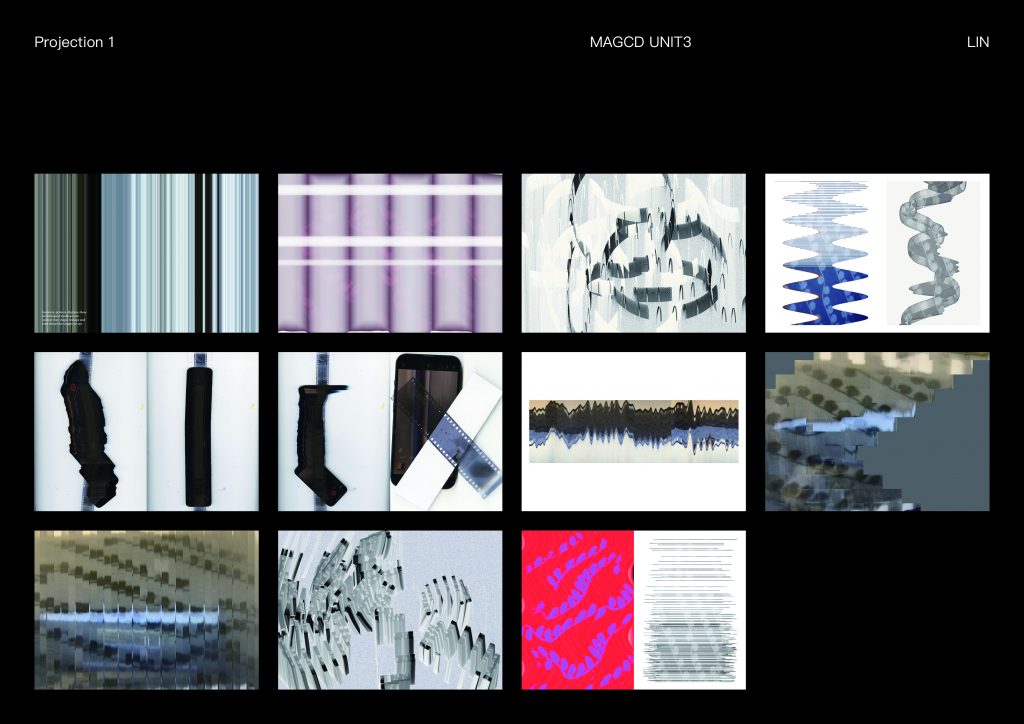
- Applying varying degrees of blur, stretching, and cropping to simulate photography’s “deconstruction”;
- Allowing audiences to physically interact with printed digital images, experiencing their materiality firsthand (Kittler, 1999).
These methods suggest that photography’s viewing paradigm has shifted—from direct observation of a physical image to indirect experience through screens, scanning, and printing.
4. At What Point is it No Longer Photography?
Does photography lose its essence at a certain threshold? If an image is compressed, blurred, or altered beyond recognition, can it still be called photography? Steyerl (2009) proposed that “low-resolution images” have become an integral part of contemporary visual culture, representing the fluidity of digital images rather than their static documentation.
In my experiments, I attempted:
- Blurring an image in increments to determine when audiences can no longer recognize its original content;
- Using Gaussian blur and pixelation to gradually transform the image from “recognizable” to “abstract”;
- Studying audience responses to these images, identifying the threshold at which they cease to perceive them as photography and begin interpreting them as another form of visual art.
These experiments reveal that photography does not have a fixed boundary but is constantly evolving in the digital age. When an image becomes sufficiently abstract, it may still carry traces of its photographic origin, yet no longer function as photography in a traditional sense.
Conclusion
This study explored photography’s transformation in the digitalization process through an experimental practice and materialized this process into a printed publication. The scanner is not merely a tool for reproducing film but actively reshapes images, causing them to drift between physical and digital states. This exploration is not only about photography itself but also about how contemporary visual culture is shaped and redefined by technology.
Through “Manual of Image Degradation,” I hope to prompt audiences to reflect on:
- How does photography’s digitization alter our way of seeing?
- At what point is it no longer photography?
- How do we redefine the essence of photography in the digital era?
Perhaps the future of photography will no longer be about recording reality but will instead become an ongoing experiment in technology, perception, and media transformation.
References
- Batchen, G. (1999). Each Wild Idea: Writing, Photography, History. MIT Press.
- Benjamin, W. (1936). The Work of Art in the Age of Mechanical Reproduction. Schocken Books.
- Manovich, L. (2001). The Language of New Media. MIT Press.
- Mitchell, W. J. (1992). The Reconfigured Eye: Visual Truth in the Post-Photographic Era. MIT Press.
- Bazin, A. (1960). What is Cinema?. University of California Press.
- Steyerl, H. (2009). In Defense of the Poor Image. E-flux Journal.
- Kittler, F. (1999). Gramophone, Film, Typewriter. Stanford University Press.
- Crary, J. (1990). Techniques of the Observer: On Vision and Modernity in the Nineteenth Century. MIT Press.
- Ritchin, F. (2013). Bending the Frame: Photojournalism, Documentary, and the Citizen. Aperture.
- Sekula, A. (1984). Photography Against the Grain: Essays and Photo Works 1973–1983. MIT Press.